
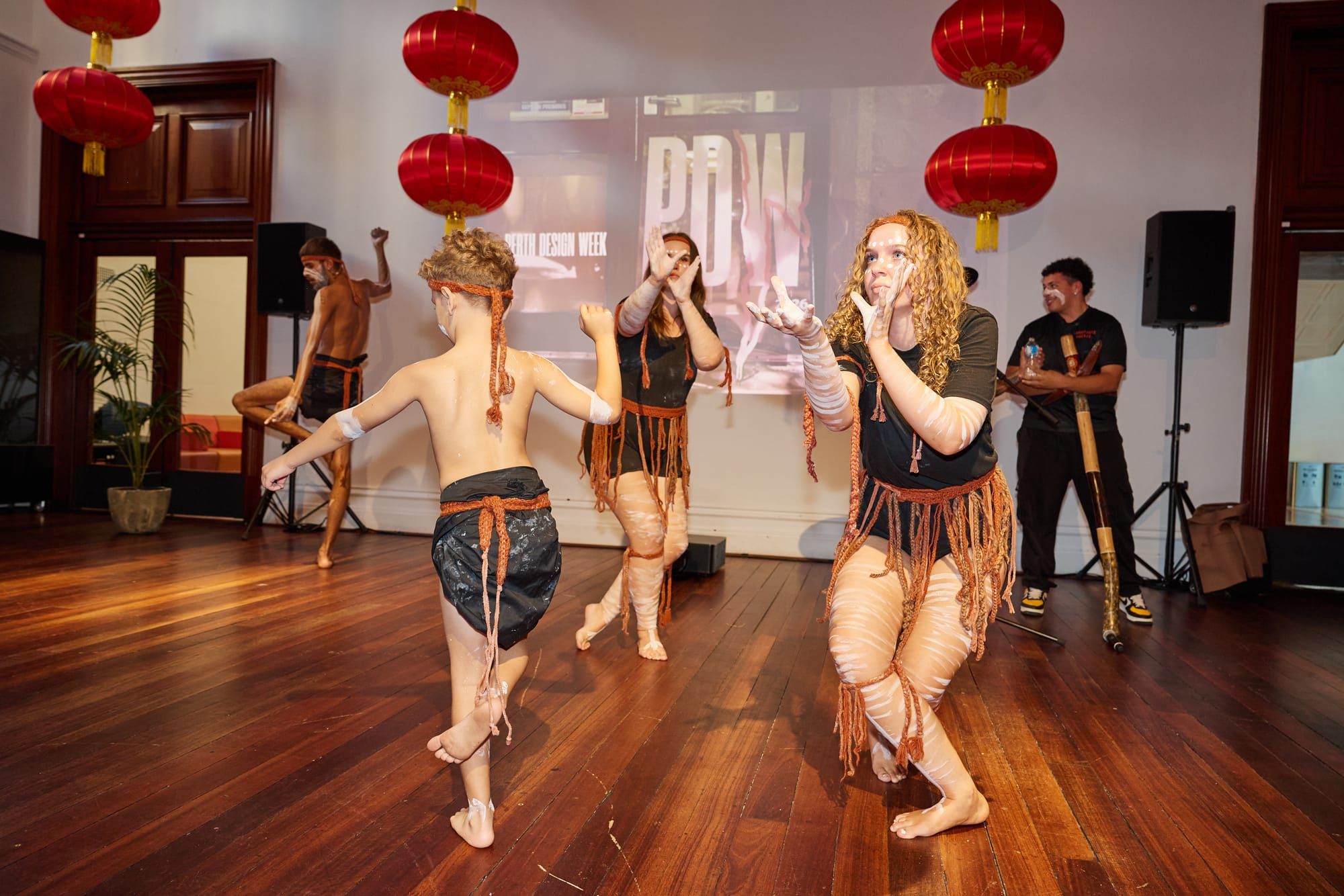
PDW Advocacy: Submission on the National Cultural Policy
The Australian Government is developing a new National Cultural Policy to shape the future direction of the creative and cultural sector. The community was invited to share their views to help guide the new Policy. The consultation closes today, Sunday 24 May 2026. The following is Perth Design Week's submission.
_
Perth Design Week appreciates the opportunity to be a part of this important conversation on Australia’s new National Cultural Policy.
Our recommendations are as follows:
A new pillar – Children are the future
Recommendation: Elevate children to a primary pillar
Children are our future and yet the current Policy’s discussion of children is limited to in-school activities (page 59) and engagement through digital platforms and television (pages 85-88). The Policy mentions children only 21 times across 113 pages.
We need to go further.
Australia is a sporting nation – and that’s by design. Policy settings for culture need to mirror our national commitment to sport, embedding the arts into community life from childhood.
The benefits of arts, culture and creativity are far-reaching, delivering social and economic benefit to individuals, communities and the country. Participation in the arts strengthens belonging, identity, education, wellbeing, social cohesion, regional liveability and Australia’s relationship with the world.
As the current Policy identifies, Australia needs stronger policy settings for cultural demand. Supporting artists and production is essential, but the system will remain fragile without investment in audiences, lifelong participation and the conditions that make cultural participation normal and accessible for all – and this starts with children.
Studies show that engaging children builds deep brand loyalty. This happens with sports – and even in banking, where children are given piggy banks to transition them into lifelong clients.
Proposed actions:
· The Australian Government needs to support active participation for children both in-school and beyond the school yard, including access to live performances and community-based activities.
· Children focussed cultural organisations are on the verge of extinction. Those remaining need to be supported.
· Cultural organisations generally (dance, opera, orchestra, theatre companies, galleries and museums) need to be supported to provide programs, performances and excursions specifically for children.
· For regional, and suburban schools, there should be support for cultural organisations to visit schools for performance based incursions.
· “Design” should be included in the existing action to “Support specialist in-school arts education programs …” (at pages 59 and 102). Noting, in the Australian Curriculum design sits with technology rather than arts.
· Recognition that consumption by children of culture via digital platforms (including games and screen productions) needs to be carefully managed. This is discussed further below.
Recommendation: Coordinate sustained investment across government
For children to have the opportunity to engage in arts, culture and creativity, implementation requires adequate funding, and coordination across all jurisdictions and all levels of government. Just as the Australian Government invests heavily in road infrastructure for public safety, cultural investment is essential for public wellbeing.
Countless studies haves shown that engaging with arts and culture provides profound physical and mental health benefits. This is critically important with the current epidemic of youth mental health challenges. Cultural events and community art programs bring people together, creating robust social support networks that prevent isolation which can lead to mental health challenges.
As an example, our key exhibition for Perth Design Week 2026 celebrated the three-decade creative journey of leading Noongar artist and designer Peter Farmer. “Chirriger Moort” honoured Peter’s deep connection to Country, culture, and family (moort). Peter’s wife Miranda tells the story of how the young people in her community who were not interested in sport had no place to go to connect. Motivated by this, Peter and Miranda funded and created a series of fashion shows at their local shopping centre to engage creative youth – to give them a sense of community.
Proposed action:
· We need arts, culture and creative pursuits to be organised – and funded – in the same manner as sports and roads, to ensure all children have a place where they belong.
Pillars 1 and 2: First Nations first and A place for every story
Recommendation: Recognition that architecture is not only the setting for cultural activities, but also an enduring expression of culture itself
While the current Policy notes that places, such as the Sydney Opera House, contribute to our sense of national belonging, and highlights the important role architects play in shaping Australia’s built environment (page 42), it could go further in highlighting the role of architecture – not only in creating the setting for cultural activities, but also as an enduring expression of culture itself.
Proposed actions:
· Strengthen funding, procurement and project-development to support First Nations cultural authority, leadership and Country-centred design approaches for the built environment.
· Expand on the current action (at page 43 and 99) “Link with the future National Urban Policy Framework to find opportunities to leverage arts and culture …” to include leveraging architecture and design.
· Expand on the current action (at page 43 and 99) “Invest in local arts and cultural infrastructure across Australia …” (at page 43 and 99) with the requirement to embed design quality, cultural value and whole-of-life public benefit into Commonwealth-supported cultural infrastructure.
· Embed adaptive reuse and heritage renewal within cultural policy to sustain the
ongoing cultural and civic value of existing places.
· Require Commonwealth-supported projects to demonstrate best-practice sustainability outcomes and design excellence.
Pillars 3 and 4: Centrality of the Artist and Strong cultural infrastructure
Recommendation: Acknowledgement of the design disciplines
Cultural activity takes many forms. As the current Policy notes (on page 11), culture includes our stories, music, paintings, craft, films, games, songs, dance, architecture and design.
Like many forms of cultural activity, design is part of everyday life and accessible to everyone. Walk down a city or suburban street – it has all been designed. Your home and everything inside it, the objects you use and the clothes you wear have all been designed.
Despite its significance, design often goes unnoticed and even in the current Policy receives limited attention beyond the initial acknowledgment. Fashion design is referred to only in a case study, with no action items proposed to elevate this art form. Graphic design is mentioned once, while furniture design is not mentioned at all. Architecture is mentioned only in relation to Pillar 2.
Many Australian architects and designers are working globally, and the Policy represents an opportunity to elevate others. For example, Zimmermann, a prominent Australian fashion business, is a global success story with a billion-dollar business. Recently, Australian based Cox architects won an award for "World's Most Beautiful" for their design of the Oman Across Ages Museum.
Promoting Australian architects and designers can drive global export growth, build cultural identity, while creating local jobs and cementing Australia’s reputation as a global leader in creative industries.
Proposed actions:
· Where relevant, extend current actions under the Policy to “designers” and “architects” as well as “artists”.
Recommendation: Acknowledgement of the support ecosystem for artists and infrastructure
It’s important to recognise that cultural infrastructure extends beyond the built form. Every aspect within our theatres, concert halls, and galleries is designed – from the set, lighting and costumes, to the graphic and web design which support promotion.
Currently, lighting technicians and costume designers are mentioned only in passing in the introduction to the Policy (at page 13).
Proposed actions:
· Investment in physical assets, and support for artists, must be complemented by investment in the people who animate these assets and enhance their productivity – including the people who design and make the sets, lighting and costumes.
Pillar 5: Engaging the audience
Recommendation: Balance online opportunities with a focus on in-person connection
The current Policy includes a significant discussion of engaging audiences through digital games and details action items to support gaming (pages 85-86) but leaves unexplored significant opportunities to engage through other activities.
While acknowledging the economic benefits of digital games, there are downsides – particularly for children – including potential social isolation.
Gaming may offer online connection but lacks the nuances of face-to-face interaction. Studies have shown this can impair real-life social development, leading to loneliness and social anxiety.
Many of the documented benefits of arts, culture and creativity are derived from in-person activities and participation.
Proposed action:
· In light of the Australian Government’s 2025 social media ban for young people, introduced to protect their safety and wellbeing online, the Policy’s current focus on digital gaming should be reconsidered.
Recommendation: Consider incentives for other cultural industries
In the Action Items (pages 86 and 105), “Tax Offsets” are mentioned in relation to screen and digital games only. Similar ideas could be applied to fashion and furniture. Several countries use tax systems to shape their fashion industries, ranging from design grants to R&D credits.
Fashion and furniture, in particular, have potential for both global impact and grassroots connection.
Proposed action:
· Explore opportunities to expand “Tax Offsets”, currently limited to screen and digital games, to shape other creative industries.
Recommendation: Support design festivals
Perth Design Week is one of many design festivals across the country – showcasing Australian design talent and engaging the community and industry in conversations on design.
Design festivals not only serve as critical incubators for emerging creative talent but also serve as powerful platforms elevating the global brand of the host city and nation. For example, in just four years Perth Design Week has placed Perth on the global design map, including a Memorandum of Understanding with the Consulate of Italy in Perth.
Milan Design Week is heavily supported by the Italian government, recognizing the sector's strategic importance to the economy. Milan Design Week generates hundreds of millions in tourism revenue and serves as a critical global sales platform for a design sector that accounts for 2.3% of the Italy's GDP.
Proposed actions:
· Explore opportunities to expand support for festivals to include design festivals.
· In addition to research on the national qualitative, quantitative and economic impact of music festivals (at pages 85 and 103), expand this research to cover other festivals, including design festivals.
_
About Perth Design Week
Since its launch in October 2022, Perth Design Week (PDW) has quickly established itself as a leading platform for showcasing design excellence and thought-provoking discussions on issues shaping Western Australia and beyond.
PDW's annual programs of exhibitions, conversations and experiences is based on successful Design Weeks across Australia and around the world. With the creation of PDW, Perth can now take its place among the great cities of the world where interest and value in good design is celebrated with a dedicated public festival.
Our city’s Design Week highlights and acknowledges local design leaders. It’s an opportunity to recognise our design community is incredibly diverse, comprised of people working across many disciplines – architecture, interiors, landscape, planning, fashion, graphic design, service design, product design and more. It’s about design at all scales, all working to a common goal – to improve how we all live and work here in WA.
Thank you
Perth Design Week thanks the Australian Government for the opportunity to be a part of this important conversation on the National Cultural Policy and for its commitment to arts, culture and creativity.
We look forward to a new Policy which builds on the excellent work of Revive, strengthening the systems, investment settings, public understanding, workforce conditions and audience development strategies that make cultural life visible, sustainable and central to national life.
_
Yours sincerely
Sandy Anghie
Chair – Perth Design Week